
'A key reason for the strong interest in IPOs has been an increased focus on profitability and reasonable pricing of deals.'

The domestic equity markets are expected to extend gains following the strong showing of the Narendra Modi-led Bharatiya Janata Party (BJP) in the state elections - a crucial precursor to the general elections in May. The BJP decisively secured victories in three of the four key states - Madhya Pradesh, Rajasthan, and Chhattisgarh. While the battles in these three states were closely contested, the scale of the BJP's triumph has surprised many, heightening expectations for regime continuity in 2024 - a positive catalyst for the markets.

Higher valuation creation in companies beyond the top 100 has given the domestic markets a shot at a $4 trillion market capitalisation (mcap) - a club exclusive to three countries currently. On November 23, the mcap of all BSE-listed stocks finished at a new record of Rs 328.33 trillion ($3.94 trillion), despite the benchmark indices ending with losses. The mcap was propelled by gains in the broader market, including small and midcap stocks - a trend dominant this year.

The Federal Retirement Thrift Investment Board's (FRTIB), one of the US government's main retirement funds, decision to change the benchmark index for gaining international exposure will channel $3.6 billion (Rs 30,000 crore) inflows into domestic equities. India has a weightage of 5.3 per cent, seventh-most in the new MSCI ACWI IMI ex USA ex China ex Hong Index, which FRTIB now plans to use. India isn't part of the current developed markets-dominated MSCI EAFE index that the pension fund uses.

India Inc's net profit as a percentage of the country's gross domestic product (GDP) is just shy of reaching 5 per cent, bolstered by strong earnings growth in the second quarter of 2023-24. Analysts interpret this as an indication that a corporate profit upcycle is in progress, with projections suggesting that this share could exceed 8 per cent within the next five years, driven by bullish earnings growth expectations. "We believe we are only halfway through a profit cycle, with the profit share in GDP rising from a low of 2 per cent in 2020 to about 5 per cent currently, and likely heading to 8 per cent in the coming four to five years. "This implies about 20 per cent compounding of earnings growth. "Underscoring this forecast is the start of a new private capex cycle, under-geared balance sheets, a healthy banking system, lower corporate tax rates, improving terms of trade, and structural consumption demand outlook albeit somewhat offset by likely consolidation in government deficit," said Ridham Desai, managing director, head of research, Morgan Stanley India in a note.

Her reasoning is simple, "It's a Tata company. No shareholder will let go of this opportunity," she told Business Standard. When asked if the other reason for lining up for the IPO is the technology sector and the fact that the combination of Tata and tech is happening after almost two decades, she replied: "The name of the company and the group matter. Tata means stability and credibility," she added.

The benchmark National Stock Exchange Nifty has rallied 4 per cent, or 750 points, from this month's low to end at 19,732 on week ending November 17. Technical analysts say the market could consolidate around the current levels as it is nearing the resistance zone. "The near-term uptrend status of the market remains intact, but there is a possibility of some more consolidation or minor weakness for the Nifty in the next one to two sessions.

The Indian equity markets have significantly increased in importance within the emerging market (EM) basket of stocks in recent years. Since 2018, India's weighting in the Morgan Stanley Capital International (MSCI) EM Index - tracked by passive funds with assets of nearly $500 billion - has doubled, while the number of domestic stocks has grown by almost 70 per cent.

Equity markets rallied after softer-than-expected inflation data in the US and UK rekindled hopes of the end of the rate-hiking cycle by major central banks. The soft inflation reading drove down bond yields and the US dollar, whetting the appetite for risky assets. The 10-year US bond yield fell below 4.5 per cent after topping 5 per cent less than a month ago.

IndusInd Bank, Suzlon, and Paytm will remain under focus, as the stocks are pegged to get added to the MSCI global standard index. These stocks, along with six others, are seen attracting cumulative inflows of nearly $2 billion from passive funds tracking MSCI indices. Persistent Systems, APL Apollo, Polycab, Macrotech Developers, Tata Motors DVR, and Tata Communication are the other six stocks that will be added to the MSCI index, shows an analysis done by Nuvama Alternative & Quantitative Research.

Diwali fireworks are expected to continue on Dalal Street next week, with four companies collectively seeking to mobilise over Rs 6,600 crore through initial public offerings (IPOs). In terms of the amount raised, this is poised to be the busiest week of calendar year 2023. Tata Technologies (Tata Tech), a subsidiary of Tata Motors, could lead the charge with an IPO projected to be over Rs 2,900 crore. This will mark the first maiden share sale by a Tata Group firm in nearly two decades.

'...similar to the 2008 global financial crisis, the 2012 taper tantrum, or the 2018 midcap crash.' 'This could lead to a substantial decline in activity and revenues for the broking industry.' 'When this will happen is uncertain, but as brokers, we must be prepared for such a downturn.'

Domestic investors are tightening their grip on the ownership of listed companies. The gap between the shareholding of domestic institutional investors (DIIs) and foreign portfolio investors (FPIs) narrowed to 13.11 percentage points at the end of the September 2023 quarter. At the peak, the gap was nearly 50 percentage points in March 2015, according to an analysis by Prime Database, a leading provider of data on the capital market.
In the current calendar year, small and medium enterprises (SMEs) have witnessed an impressive surge in initial public offerings (IPOs), surpassing the 2018 record. Over 150 SME IPOs have been introduced to the market, breaking the previous record of 141 set in 2018. According to data from PRIME Database, a primary market tracking firm, 147 companies successfully concluded their debut share sales by the end of October, raising a cumulative Rs 3,727 crore.

South Korea's move to ban stock short-selling may further delay its quest to bag an 'upgrade' to 'developed market' status from global index provider MSCI, said analysts. South Korea will prohibit stock short-selling until June 2024 to allow its regulators to "actively" improve rules and systems. South Korea is currently classified as an 'emerging market (EM)' alongside India, China and Taiwan in MSCI indices.

This is the case even though the benchmark index is only 5 per cent below its all-time high. The list of stocks trading at a discount primarily consists companies in the automotive, banking, oil and gas, insurance, healthcare, and metal sectors.
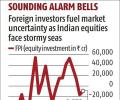
Foreign portfolio investors (FPIs) have withdrawn Rs 25,305 crore from domestic markets since September. FPIs were net sellers in the first two months of 2023, but from March to August, they purchased equities worth Rs 1.7 trillion. This selling trend has caused the National Stock Exchange Nifty Index to decline by 3.2 per cent from its September highs. FPI selling initially began in September as profit-taking but intensified due to rising US bond yields and uncertainty regarding the rate hike trajectory.

Draft Red Herring Prospectus (DRHP) filing continued to be robust in October, signifying the optimism in the initial public offer (IPO) market despite the recent turbulence in equities. In October, 17 companies filed their offer documents for IPOs. The rush in filings has made August-October 2023 the best three-month period for DRHP filings since July-September 2021.

The fees charged by investment banks to manage initial public offerings (IPOs) have increased to an average 3.23 per cent of the issue size this calendar year, the highest since 2020. The average fee is up 8 per cent compared to last year, when it stood at 2.99 per cent. The investment banking fees have increased as the average IPO size has shrunk this year.

As many as 267 of 453 companies from the BSE500 index are trading above their consensus price targets, according to the data compiled by Bloomberg. Not all companies in the BSE500 index are tracked by analysts.
 © 2026 Rediff.com - Advertise with us - Disclaimer - Privacy Policy - Sitemap - Feedback - About us - Terms of use - Grievances